Bhishma's vow
A prince gives up a throne, and a family, so that his father can be happy. The promise shapes everything that follows.
King Shantanu of Hastinapura once met a beautiful woman by the river Ganga and asked her to marry him. “I will,” she said, “but you must never question anything I do. The day you do, I will leave.” The king agreed. She was the river goddess Ganga herself.
Their eighth son was a strong and clever boy named Devavrata. When Shantanu broke his promise and questioned her, Ganga took the baby and returned to the river. Years later she came back with Devavrata grown into a young man, trained in every weapon and every holy book, and gave him to his father. Shantanu made him crown prince, and the kingdom rejoiced.
One day, by the Yamuna river, Shantanu met Satyavati, a fisherman chief's daughter, and fell in love. But her father had a condition. “Only if her son becomes king after you.” Shantanu could not take the throne from his good son Devavrata. He went home silent and sad, and grew thinner every day.
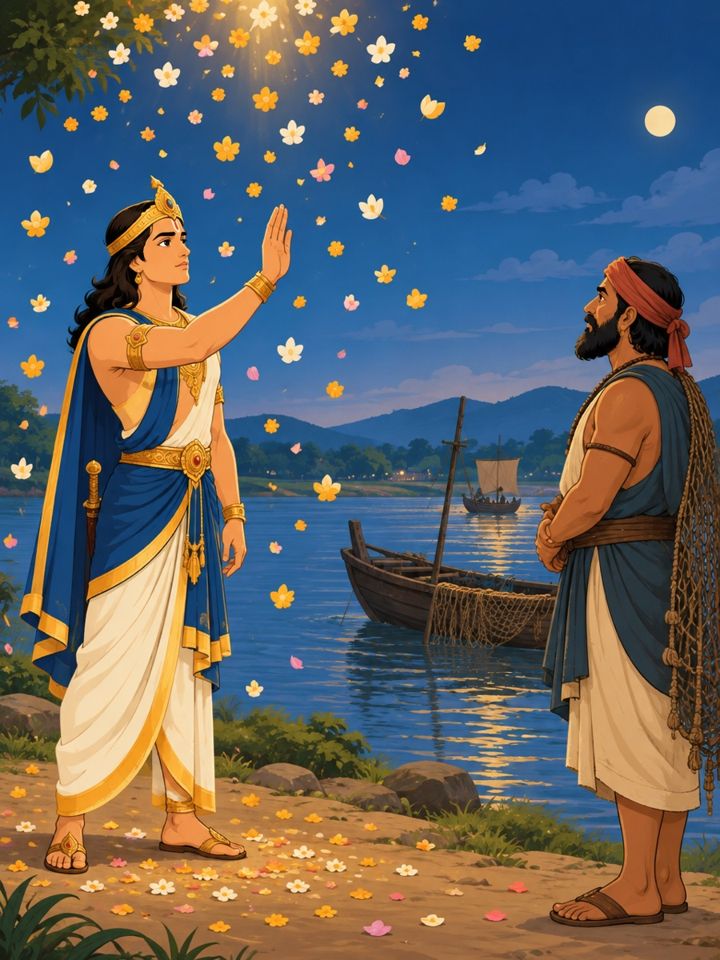
Devavrata found out why. He went straight to the fisherman. “I give up the throne,” he said. “Satyavati's son will be king.” The fisherman was still not satisfied. “But your children may fight for it one day.”
Devavrata raised his hand. “Then hear this. I will never marry, and I will never have children. I will spend my whole life serving whoever sits on the throne of Hastinapura.”
The gods in the sky showered flowers on him and cried out, “Bhishma! Bhishma!” It means the one who took a terrible vow. From that day on, that was his name.
Shantanu was so moved that he gave his son a boon. “Death will not come to you until you choose it.” Bhishma kept his vow for the rest of his very long life, guarding the family as a grandfather to the Pandavas and the Kauravas. Not even he could stop the quarrel that was coming.
For older listeners
Ganga had already taken her first seven sons back into the river. They were the eight Vasus, gods cursed to be born on earth, and she was freeing them quickly. The eighth, Devavrata, had to live a full human life. Shantanu questioned her when she was about to take him too.
Many readers see Bhishma's vow as both noble and tragic. Because he could not be king, he spent his life serving weaker rulers, and in the great war he fought on the side he knew was wrong because of his oath to the throne.